Avatars and digital identity: who are you in a virtual world?
In a video call you are a face in a rectangle. In a virtual world you are a body in a room — and that body changes how others treat you, how you behave, and who gets to control the version of you online.
In a video call you are a face in a rectangle. In a virtual world you are a body in a room — one you choose, and one that other people react to. That small difference has large consequences: for how we behave, for how we are treated, and for who controls the version of us that lives online.
A short taxonomy
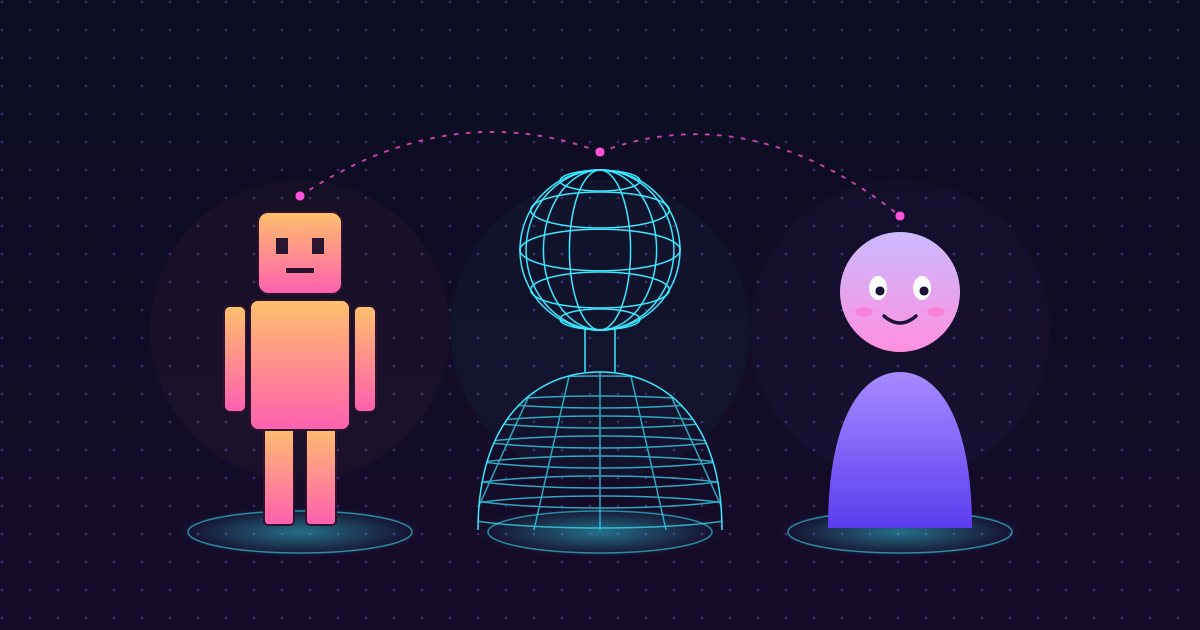
Avatars come in roughly four styles, and each platform’s choice says a lot about what it is for.
- Stylised and blocky. Roblox and Minecraft characters are deliberately simple. They are cheap to render on any device, easy to customise, and they sidestep the uncanny valley entirely.
- Cartoon-expressive. Many social apps use exaggerated, friendly figures with big eyes and readable expressions. They prioritise emotion over realism.
- User-made. In communities such as VRChat, people upload their own models, often in an anime style and frequently built on the open VRM format that originated in Japan. Identity here is a craft, and a good avatar can take weeks to make.
- Photorealistic. At the other end are scanned, lifelike representations such as Apple’s Personas on Vision Pro, or the research “codec avatars” Meta has demonstrated. They aim to make remote presence feel like sharing a room.
The uncanny valley is still there
In 1970 the roboticist Masahiro Mori observed that as artificial figures become more human-like, our affinity for them rises — until, just short of perfect realism, it drops sharply into discomfort. Half a century later, avatar designers still navigate his uncanny valley. A cartoon that blinks slightly wrong is charming; a near-photoreal face that does the same is unsettling. Realistic avatars must get eye contact, micro-expressions and lip sync almost exactly right, which is why so much effort goes into face and eye tracking on new headsets.
Your avatar changes you
Avatars are not only how others see us. They also shape how we act. In 2007 Stanford researchers Nick Yee and Jeremy Bailenson described the Proteus effect: people given taller avatars negotiated more assertively, and people given more attractive avatars stood closer to strangers and disclosed more about themselves. Later studies have found similar effects for age, strength and other traits. For teachers and therapists this is an opportunity. For platform designers it is a responsibility: the default body you hand someone is never a neutral choice.
Who owns the face?
The harder questions are about control. In most virtual worlds your avatar is an entry in someone else’s database. You can dress it up, sometimes spending real money to do so, but you generally cannot take it with you when you leave. If your account is closed, your appearance, your history and your purchases go with it.
Several efforts are trying to change that. Open formats such as VRM and glTF make it technically possible to carry a model between applications. Cross-platform avatar services let developers accept a single character across many games. Some proposals go further and suggest that identity should sit in an account the user, not the platform, controls. None of these has become the default, and all of them run into a practical problem: a body designed for one world’s art style, physics and rules rarely looks or behaves right in another.
Safety and consent
Embodiment also makes harassment feel more physical. An insult in a chat window is unpleasant; someone’s avatar walking up and invading your personal space while you wear a headset can feel genuinely threatening. Most social VR platforms now offer personal boundaries — an invisible bubble other avatars cannot enter — along with quick ways to mute, block and leave. These features are easy to dismiss as details, but they are the virtual-world equivalent of building codes, and the platforms that took them seriously early have tended to keep their communities longer.
Realistic avatars raise a further issue: if a convincing replica of your face and voice can be produced, so can an unauthorised one. Verification, watermarking and clear rules about likeness rights are becoming part of the conversation, much as they are for synthetic media in general.
Where this is heading
The likely future is not one avatar to rule them all but a wardrobe: a realistic version for work meetings, a stylised one for games, an expressive one for friends, all recognisably tied to the same person. Getting there needs open formats, sensible defaults, portable reputations and the right to leave with your face intact. That is less a graphics problem than a governance one — and it is one of the reasons we keep returning to interoperability on this site.