What a metaverse actually is (and what it isn’t)
Strip away the keynote slides and the word still describes something real: persistent, shared, three-dimensional places that people return to. Here is a working definition we can actually use.
Few technology words have travelled as far, as fast and with as little luggage as “metaverse”. In the space of about a year it went from a term used mostly by game developers and science-fiction readers to a line item in quarterly earnings calls. Then, almost as quickly, it became the thing companies stopped saying out loud. Neither the hype nor the backlash told us very much about what the word means. So let’s try to pin it down.
A working definition
The most useful definitions share a few ingredients. A metaverse is a network of persistent, real-time, three-dimensional spaces that many people can occupy at the same time, in which their identity, their belongings and their relationships carry over from one visit to the next. The investor and essayist Matthew Ball, whose 2022 book on the subject is still the most cited attempt at a definition, adds interoperability and a working economy to that list, and talks about a massively scaled network rather than any single place.
Each of those words does real work:
- Persistent means the world keeps existing when you log off. A video call ends; a town square does not.
- Real-time and shared means you experience the same moment as everybody else who is there, not a recording of it.
- Three-dimensional means space matters: where you stand, who is near you, what you can see and hear from there.
- Continuity of identity means you are recognisably the same person tomorrow, with the same name, the same avatar, the same friends and the same things you made or bought.
What it is not
It is worth being equally clear about what a metaverse is not, because most confusion comes from mistaking one of its parts for the whole.
It is not the same thing as virtual reality. A headset is one way in, and for some experiences the best one, but most people who spend time in shared 3D worlds today do so on a phone, a console or a laptop. Roblox, Fortnite and Minecraft count their monthly players in the tens or hundreds of millions, and almost none of them are wearing a headset.
It is not a single product. No company owns “the” metaverse any more than one company owns the web. When a firm says it is building the metaverse, what it usually means is that it is building a world, a platform or a device it hopes will become an important part of one.
It is not synonymous with crypto. Blockchain-based ownership is one proposal for how digital goods could move between worlds. It is not a requirement, and most of the busiest virtual worlds do not use it at all.
The web analogy, and its limits
The comparison people reach for most often is the early web, and it is a good one up to a point. In 1994 there were websites, but there was no shared sense of what the web would be for. The pieces that made it valuable — HTTP, HTML, the humble link — were open and boring in exactly the right way. Anyone could publish, and any browser could read what they published.
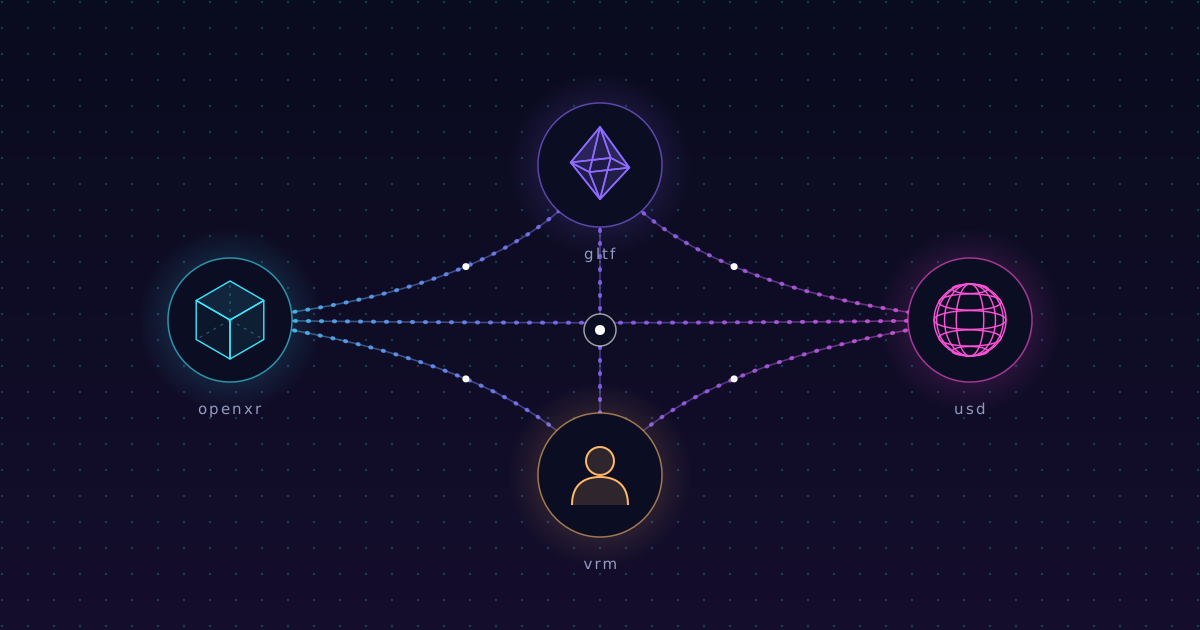
Virtual worlds today look more like the online services of the early 1990s: large, impressive and mostly walled. Your avatar in one game cannot walk into another. Your purchases do not follow you. Friends lists, chat and voice rarely cross platform boundaries. Much of the interesting work happening now, from 3D file formats to cross-platform avatar specifications, is an attempt to build the open layer that would let these gardens connect. We cover that effort in our piece on open standards.
The analogy breaks down in one important way: a web page is cheap to make and cheap to serve. A convincing, shared, real-time 3D space is neither. It needs content, servers close to its users, moderation, and devices capable of rendering it. That cost structure is one reason the field has consolidated around a few large platforms.
So is it here yet?
Partly. If you define the metaverse as a single seamless, interoperable universe, then no, and it may never arrive in that form. If you define it as the gradual shift of more social, creative and commercial life into persistent shared 3D spaces, then it has been arriving, unevenly, for decades — through text-based MUDs, Second Life, massively multiplayer games, social VR and, increasingly, industrial simulations and digital twins. Our short history traces that path.
That second definition is less exciting, but it is more useful. It lets us ask practical questions. Which experiences actually benefit from being shared and spatial? Who owns the identity layer? What does good moderation look like when harassment has a body and a voice? Those are the questions this publication exists to follow.
Updated in February 2026 with current player figures and links to our later explainers.