Virtual concerts and live events: what actually works
From Fortnite blockbusters to weekly club nights in social VR and digital performers on real stages: six years of evidence on why people turn up to virtual shows — and why they don’t.
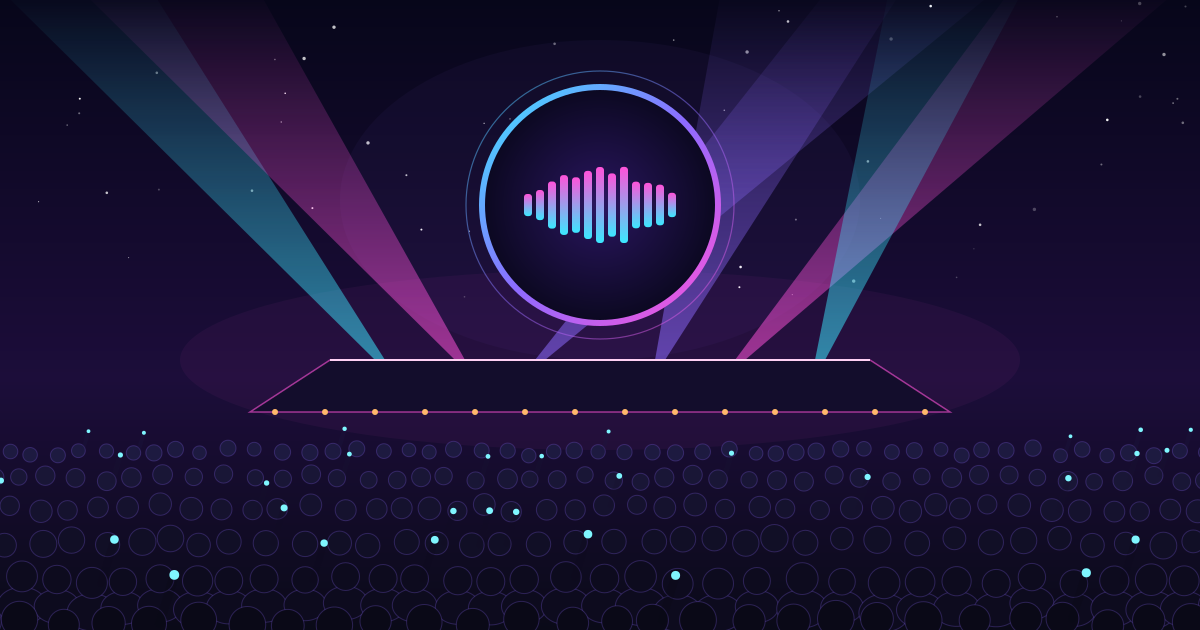
Every few months someone declares that virtual concerts are the future of live music, and every few months someone else points out that nobody ever cried at a hologram. Both are partly right. Six years after the lockdown boom, there is enough evidence to say which kinds of virtual events people actually show up for, and why.
The blockbuster model
The template was set inside Fortnite. In February 2019 Marshmello played a ten-minute set there to around ten million players. In April 2020 Travis Scott’s Astronomical went further: a giant version of the rapper strode across the island while the world around the players transformed with every song, and more than twelve million people attended the first show. Ariana Grande’s Rift Tour followed in 2021. On Roblox, Lil Nas X’s 2020 performance reported tens of millions of visits across its run.
These shows worked because they did things a physical stage cannot. Scale changed instantly, gravity switched off, the audience flew. They were also short, free and scheduled inside a game people were already playing. The lesson many brands drew — that you could put any artist into any world and fill it — turned out to be wrong. The audience came for spectacle and a shared moment, and later events that offered neither struggled.
The intimate model
At the other end of the spectrum are small, recurring events in social VR. On platforms such as VRChat, DJ nights, open mics, comedy clubs and dance classes run every week, organised by communities rather than labels. Attendance might be a few dozen people. What makes them work is not production value but presence: you can turn to the person next to you, recognise the regulars and come back next Friday. In other words, they behave like real venues.
The constraint is capacity. A single instance of a social VR world typically holds dozens of avatars, not thousands, because every person’s movement and voice has to reach everyone else in real time. Large events get around this by running many parallel copies of the same room, which keeps things smooth but means you never see the whole crowd.
The hybrid model
The most commercially successful “virtual” show of recent years does not need a headset at all. ABBA Voyage, which opened in a purpose-built arena in London in 2022, presents digital versions of the band, created from motion capture of the four members, alongside a live band in a physical room. It sells tickets to people who want to be in a real crowd but are happy for the performers to be digital. Variations on the idea — digital performers in real venues, or real performers streamed into virtual spaces — keep appearing, and they suggest that the line between “virtual” and “live” is the wrong one to draw.
What makes an event feel live
Across all three models, the events people remember share a few traits:
- Scarcity in time. It happens once, or at a set hour. A recording you can watch whenever you like is a video, not an event.
- A visible audience. Seeing and hearing other people react is most of the point. Spaces that hide the crowd feel empty however good the stage is.
- Agency. Being able to move, dance, emote or influence the show, even in small ways, turns viewers into participants.
- Low friction. Every extra download, account or loading screen costs a large share of the audience before the first note.
- Something only this medium can do. If the virtual version is just a worse copy of a stadium show, people will choose the stadium or a livestream.
Beyond music
The same rules apply to conferences, product launches and exhibitions. The pandemic-era attempt to recreate entire trade fairs as 3D halls mostly failed: walking a virtual corridor to reach a booth is slower than clicking a link. What does work is smaller and more social — networking rooms where you can drift between conversations as you would at a reception, poster sessions where proximity decides whom you hear, and 3D demonstrations of physical products that a video cannot convey. Avatars matter here too, as we discussed in our piece on digital identity.
The economics
For artists, the business case is still uneven. Blockbuster in-game shows are usually funded as marketing, by the platform or by brands, rather than by ticket sales. Smaller virtual venues rely on tips, merchandise and virtual goods. Building a bespoke world for a single show remains expensive, which is why reusable venues and toolkits are attracting attention. Until the economics improve, expect virtual concerts to stay what they are today: occasionally spectacular, frequently experimental, and at their best when they stop trying to imitate a stadium.